


 English
 中文简体
中文简体
 Español


A purchasing engineer sends us a drawing for a seawater valve body. The title block says "316 Stainless Steel." We ask one question before quoting: did you mean wrought AISI 316, or the cast equivalent, CF8M? The answer changes the alloy chemistry, the heat-treatment cycle, the machinability, and often the price by 10 percent or more. Most buying mistakes for 316 stainless steel castings start exactly here, because the grade name on the drawing does not automatically translate into the right cast material. This guide explains what the grade really means, how cast structures differ from wrought bar and plate, which casting process fits your parts, and where the costs actually accumulate.
Content
- 1 What "316" Means When the Part Is Cast
- 2 Cast Microstructure vs. Wrought Bar: Magnetic and Corrosion Differences
- 3 Investment Casting vs. Sand Casting for 316 Parts
- 4 What Drives the Cost of 316 Stainless Steel Castings
- 5 Where 316 Stainless Steel Castings Earn Their Keep
- 6 How to Write a 316 Casting Specification That Gets It Right
What "316" Means When the Part Is Cast
In the cast form, 316 is not specified as AISI 316. It is specified as CF8M in ASTM A351, A743, or A744, depending on service class. CF8M is the cast version of type 316, and CF3M is the cast version of type 316L. The chromium, nickel, and molybdenum windows are close but not identical, and the foundry uses the cast grade, not the wrought grade, to control melting and inspection.
Molybdenum is the element that separates 316 from 304. At 2.0 to 3.0 percent, it raises resistance to chloride pitting and crevice corrosion significantly. That one addition makes 316 castings the default choice for seawater, chemical processing, and food-contact equipment where chlorine-based sanitizers are used.
| Grade | Carbon max | Chromium | Nickel | Molybdenum |
|---|---|---|---|---|
| Wrought 316 | 0.08 | 16.0-18.0 | 10.0-14.0 | 2.0-3.0 |
| Wrought 316L | 0.03 | 16.0-18.0 | 10.0-14.0 | 2.0-3.0 |
| Cast CF8M | 0.08 | 18.0-21.0 | 9.0-12.0 | 2.0-3.0 |
| Cast CF3M | 0.03 | 18.0-21.0 | 9.0-12.0 | 2.0-3.0 |
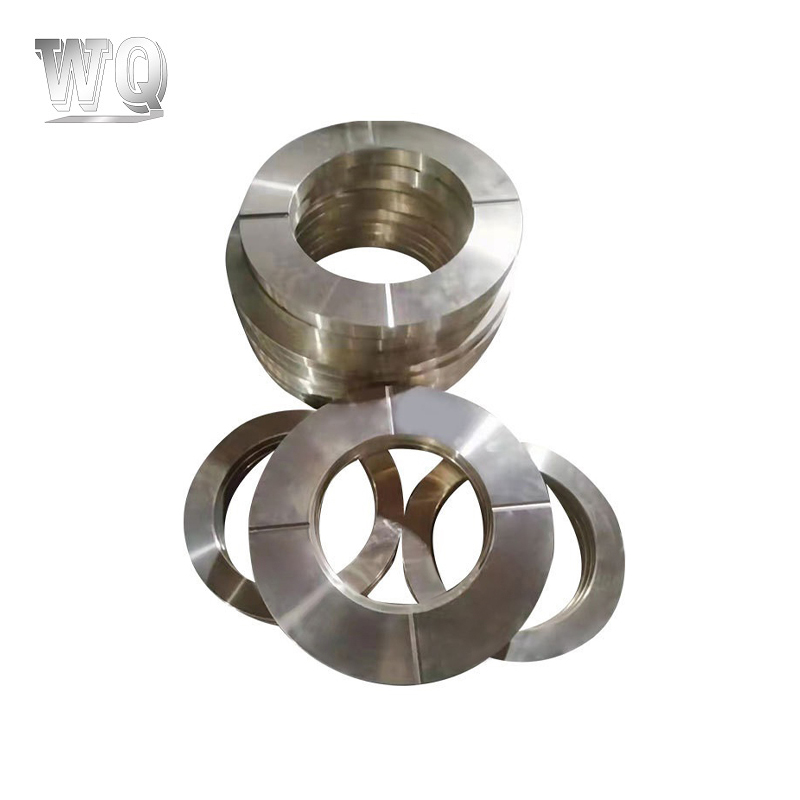 316/316L Stainless Steel Castings with Enhanced Chloride ResistanceThese castings offer molybdenum-enhanced pitting and crevice corrosion resistance for seawater, chemical processing, and food-contact equipment. The choice between CF3M and CF8M depends on welding or sensitizing conditions, so verify the grade for your service environment.View Product →
The practical rule is simple: if your component needs welding after casting, or operates in a sensitizing temperature range, specify CF3M instead of CF8M. The lower carbon content prevents chromium carbide precipitation at grain boundaries, preserving corrosion resistance.
Cast Microstructure vs. Wrought Bar: Magnetic and Corrosion Differences
A common customer complaint is that "316 castings are magnetic." This surprises people who have tested a piece of 316 plate and found it nonmagnetic. The cast version of 316, CF8M, intentionally contains 5 to 20 percent ferrite in an austenitic matrix. Ferrite is ferromagnetic, so the casting will often attract a magnet. This is not a defect and it does not mean the foundry substituted a cheaper alloy.
The ferrite content is actually controlled for a reason. It reduces hot tearing during solidification and improves weldability compared with a fully austenitic structure. The trade-off is that ferrite lowers corrosion resistance slightly at the microstructural level, which is why specifying the right heat treatment and, where necessary, the ferrite count matters when the part runs in chlorides.
If your application explicitly requires a nonmagnetic casting, write that requirement on the drawing and ask the foundry to control ferrite percentage, for example to 5 percent maximum by magnetic measurement per ASTM A799. If no such note exists, the foundry will pour to the chemistry only, and the ferrite level will sit wherever solidification puts it.
Investment Casting vs. Sand Casting for 316 Parts
The cheapest method is not always the lowest-cost method once machining, scrap, and surface finish enter the calculation. For 316 stainless steel castings, investment casting usually wins when the part has complex internal geometry, thin walls, or tight tolerances. Sand casting wins for very large parts or very low quantities. In our shop, we run both, and the selection limit is roughly about 500 grams to 50 kilograms for investment casting, with larger parts going to sand where a pattern cost can be justified.
| Parameter | Investment casting | Sand casting |
|---|---|---|
| Linear tolerance | +/- 0.5% of nominal, often 0.15 mm achievable | +/- 1.0-2.0 mm on medium section sizes |
| Surface roughness | Ra 1.6-3.2 μm | Ra 6.3-12.5 μm |
| Minimum practical wall | 1.5-2.5 mm | 4-5 mm |
| Economic batch size | 200-100,000 pieces | 1-1,000 pieces |
Stainless Steel Investment Casting for Complex GeometriesInvestment casting suits parts with intricate internal passages, thin walls, or tight tolerances. For 316 stainless steel components roughly 500 grams to 50 kilograms, it often lowers total cost by reducing machining and scrap compared to sand casting.View Product →
For a 316 pump impeller or a valve cage with cores and thin sections, investment casting reduces the need to machine internal profiles. For a 200-kilogram flanged housing, sand casting keeps the unit price realistic. The correct answer is not a brand preference; it is a geometry-and-quantity calculation. If you are unsure, a foundry that does both is more likely to give an unbiased recommendation, which is why we are direct about process suggestions in the quotation stage.
What Drives the Cost of 316 Stainless Steel Castings
316 castings cost more than 304 castings for three concrete reasons: nickel and molybdenum content, lower machinability, and stricter quality requirements. Molybdenum prices are volatile, and the alloy surcharge can swing the raw material cost of a 316 part by 10 to 20 percent within a quarter. Machining is the second major cost center. 316 work-hardens quickly, so feeds, speeds, and tool wear behave differently from low-alloy steel. A small drilled hole that takes one minute in carbon steel can take three minutes in 316, and the tool wears sooner.
The main cost drivers, in rough order of impact, are:
- Alloy raw material, especially the molybdenum surcharge.
- Machining time and tool life, which increase with part complexity.
- Solution annealing and quenching, mandatory for restoring corrosion resistance after solidification.
- Quality inspection, including chemical analysis, tensile testing, and pressure testing where applicable.
- Surface finishing requirements such as electropolishing, pickling, or glass bead blasting.
We often tell buyers to compare quotes on total landed part cost, not price per kilogram. A foundry that claims cheap 316 castings may be skipping the solution anneal, which leaves a microstructure that fails salt spray testing or corrodes in service. Ask for the heat-treatment certificate and the chemical analysis. If both are missing, the price discount is not a bargain; it is a risk transferred to your end product.
Where 316 Stainless Steel Castings Earn Their Keep
The service record of 316 castings in chloride-bearing environments is long and well documented. Marine hardware, chemical pump bodies, valve trim, heat exchangers, food processing components, and pharmaceutical equipment all rely on the molybdenum-bearing alloy. The reason is endurance: the alloy maintains its oxide layer under conditions that cause pitting in 304, and the cast form allows geometries that forged or machined bar cannot economically produce.
For example, camlock couplings for chemical transfer lines are often investment cast in 316 because the grooved end profile and sealing surfaces are expensive to machine from solid bar. The same logic applies to ice cream machine shafts and mixing components, where the product side is cleaned in place with aggressive sanitizers. You can read more in our industry notes on why stainless steel casting parts hold up so well in industrial service.
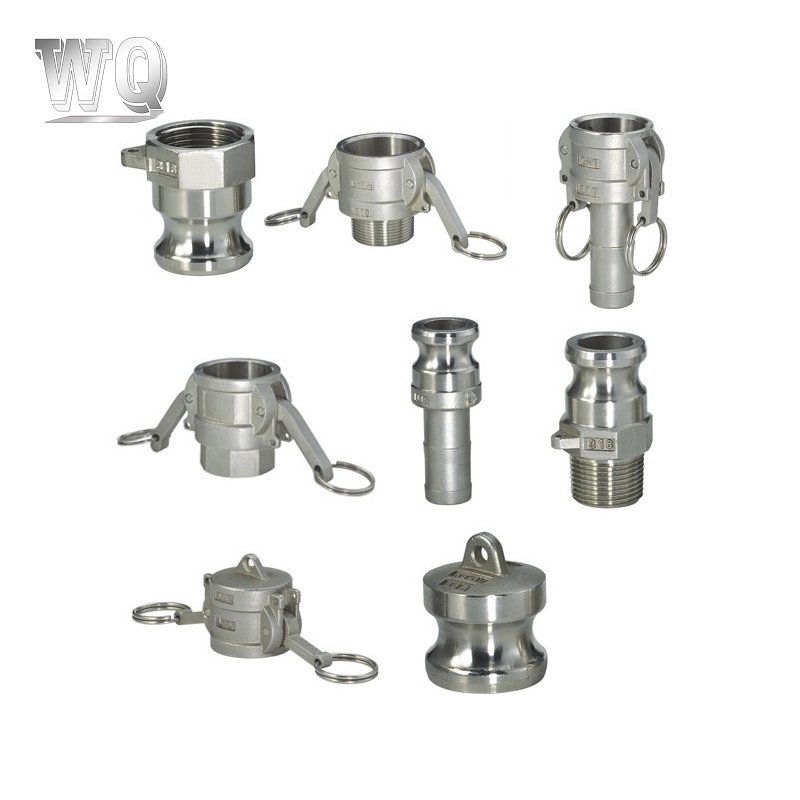 Stainless Steel Camlock Couplings for Chemical Transfer LinesThese quick-release couplings are typically investment cast in 316 because the grooved profiles and sealing surfaces are costly to machine from bar stock. The casting method preserves corrosion resistance and simplifies production of the complex end geometry.View Product →
When you are buying 316 castings for this type of duty, make sure the foundry understands the service environment, not just the drawing. A casting that works in fresh water may fail in warm seawater if the ferrite content is too high or the surfaces are not properly finished. The material grade is the foundation, not the whole design.
How to Write a 316 Casting Specification That Gets It Right
Start with a cast grade, not a wrought grade. On the drawing, write "ASTM A351 CF8M, solution annealed" or "CF3M" if the part is welded after casting. Add the mechanical property block only if your internal standard demands it; A351 already gives a minimum tensile strength of 70 ksi (485 MPa), yield strength of 30 ksi (205 MPa), and elongation of 30 percent. If corrosion resistance is safety-critical, add an intergranular corrosion test per ASTM A262, and specify the ferrite range in percent if magnetic response must be limited.
Then state the inspection scope: visual, dye penetrant, radiographic, or hydrostatic pressure. For investment castings, a dimensional report on the first article protects both sides, especially when cast datums will locate machining operations. A one-page cast-grade specification, sent with the RFQ, eliminates most of the miscommunication we see in daily quotes. You can browse our investment-cast product range to compare 316, 316L, and related grades by material and end-use category.